It’s Still Here

This story is personal. I traveled to Iran often during the 1970s—enough to glimpse a country in tension. The Shah ruled with a heavy hand, the rich were extravagantly rich, and the poor were everywhere—the gap between them impossible to ignore. But it was also a time when the culture leaned Westward—when science thrived, and education meant something. Women led research labs. They were physicians, professors, and pioneers. And oh, that food. I miss that Iran. And I worry what might be lost forever if we help destroy the chance of its return.
This week, U.S. policymakers quietly adjusted their stance on Iran—easing sanctions on humanitarian grounds, even as tensions with Tehran’s leadership remain high. But while diplomats traded statements, a teenage girl in Tabriz was arrested for drawing a butterfly without a hijab. In the detention center, she whispered something to her mother before being taken away: “Tell them why.”
Here’s my story.
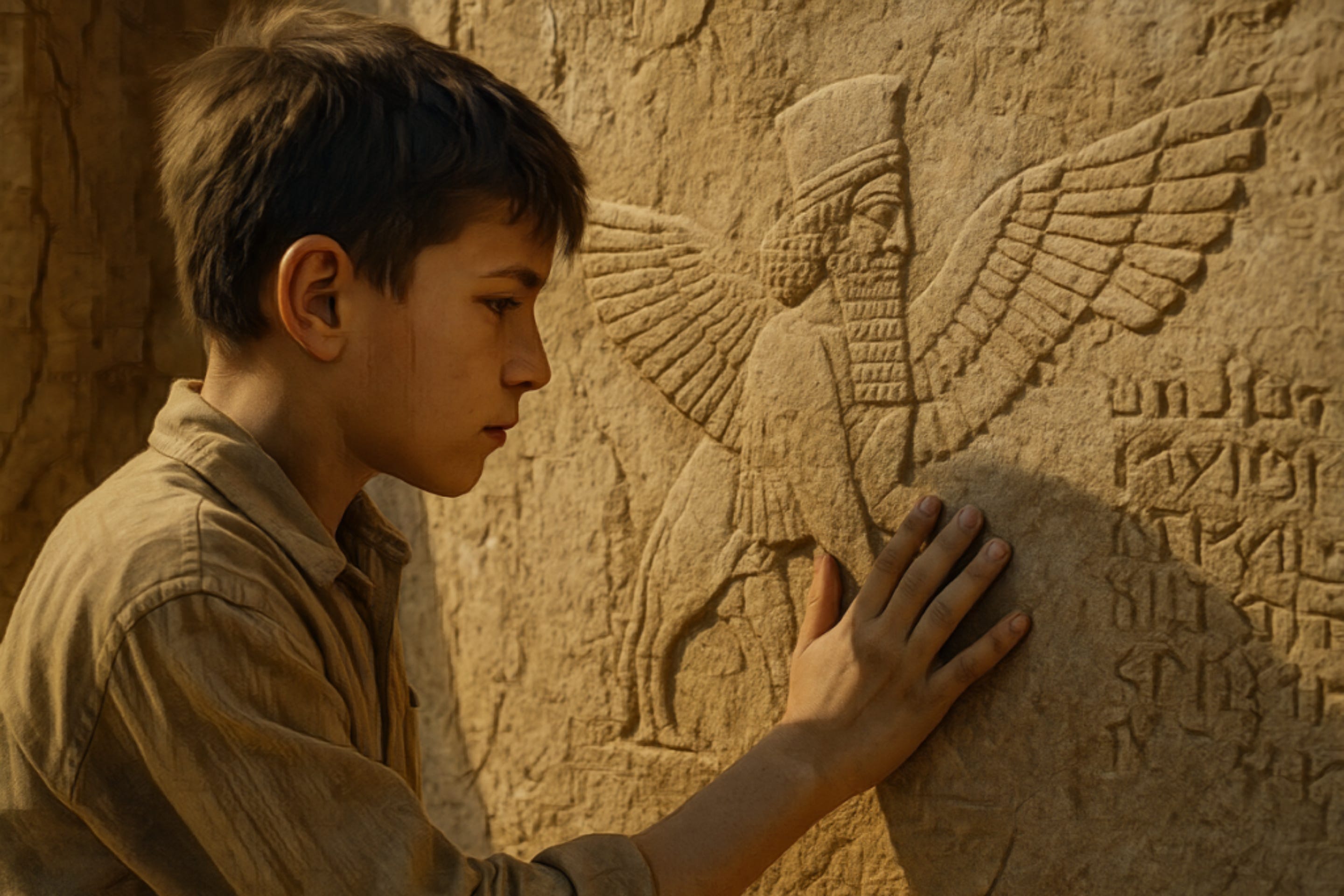
The boy was silent until they reached the ruins. Then he bent down and brushed away a layer of sand. There were carvings underneath—strange animals, ancient script.
“It’s still here,” he said.
His father nodded. “So are we.”
Iran has never vanished. Not under invaders, not under emperors, not under embargo. It survives in clay tablets and epic poems, in whispered prayers and shouted slogans. It survives because its people insist on being remembered—and on remembering.
A culture doesn’t disappear. It gets buried—until someone brushes back the sand.
In the 6th century BCE, Cyrus the Great marched into Babylon. But instead of looting it, he released the enslaved and declared religious freedom for all. His decree, known as the Cyrus Cylinder, is still studied today.
“I returned them to their places and rebuilt their sanctuaries,” it reads.
“Even now,” said a Tehran professor, “we quote Cyrus to argue for freedom. He’s not just history. He’s a weapon of hope.”
That legacy didn’t end with empire. In the medieval era, Iran produced giants of science: Al-Khwarizmi, who created algebra; Avicenna, whose Canon of Medicine ruled European universities for centuries; Al-Biruni, who measured Earth’s circumference with remarkable accuracy.
But even science came with stakes. Abu Bakr al-Razi, who ran a hospital in Ray, wrote: “The doctor’s aim is to do good, even to enemies.”
Ethics in Iran didn’t begin with politics. It began with math, medicine, and mercy.
This drive for universal knowledge, for ethics over ego, would later echo in other spheres. In Shiraz, Hafez wrote verses against hypocrisy. In Konya, Rumi’s Persian poems explored divine love. Their works survive not just as literature but as resistance.
“Poetry,” said a dissident in exile, “was the only way to say what we couldn’t say. Still is.”
By the 20th century, Iran stood at another crossroad. In 1906, after mass protests, the Qajar dynasty was forced to accept a constitution. A parliament was born. For a brief time, it seemed Iran might lead the Middle East into democracy.
Then came the Pahlavis.
Reza Shah, a soldier-turned-king, crushed tribal autonomy and unveiled women by decree. He built railroads and imposed Western dress. His son, Mohammad Reza Shah, inherited this project and accelerated it. Skyscrapers rose. Tehran lit up with neon.
But the cost was steep.
“We had buildings,” said a former teacher, “but no voice. We had money, but no meaning.”
Modernization without democracy is just oppression with glass walls.
When the Shah hosted a lavish celebration at Persepolis in 1971 to mark 2,500 years of monarchy, villagers were evicted, and guests dined on imported pheasant. The disconnect was stark.
“We watched it on a neighbor’s TV,” recalled a taxi driver. “They toasted Cyrus. We boiled lentils.”
In 1979, it all came undone.
The revolution began with mourning—for students killed, for clerics arrested, for a culture humiliated. Within months, the Shah was gone. Ayatollah Khomeini returned. The monarchy fell.
But the Islamic Republic that rose in its place was not the pluralist dream many had hoped for. It replaced one form of authoritarianism with another. The new regime executed rivals, closed universities, and enforced compulsory veiling.
“We thought we were burning the cage,” said a woman in her seventies. “But they just changed the lock.”
Every revolution burns the cage. Not every one breaks it.
When Iraq invaded in 1980, Iran was barely a year into revolution. It fought back with everything. Martyrdom became state doctrine. Young boys were given plastic keys and told they would open the gates of heaven.
“My cousin was thirteen,” one man said. “He wrote a goodbye note on the back of a math test.”
The war lasted eight years and killed over half a million. But it also cemented the Islamic Republic’s legitimacy.
After Khomeini’s death in 1989, his successor, Ali Khamenei, inherited a country hungry for relief. In 1997, voters chose Mohammad Khatami, a reformist cleric who promised civil society and “a dialogue of civilizations.”
Briefly, the country exhaled.
Newspapers returned. Students debated openly. Women published novels, attended universities, ran for office.
“I felt like I was living in color again,” one woman recalled.
But hardliners pushed back. In 2009, after a disputed presidential election, millions marched in what became the Green Movement. They chanted: “Where is my vote?” Security forces crushed the protests. Hundreds were jailed.
Reform in Iran never arrives by decree. It arrives breath by breath—until it’s choked again.
The years that followed were quieter. But not still.
In 2014, Maryam Mirzakhani became the first woman ever to win the Fields Medal, mathematics’ highest honor. Born in Tehran, she had once been told not to dream too loudly.
“She showed what Iranian girls can be,” said a classmate. “If they’re allowed.”
Then, in 2022, a name reignited the streets: Mahsa Amini.
Detained for allegedly wearing her hijab improperly, Mahsa died in custody. She was 22. Her death lit a fuse that had waited decades.
From Tehran to Tabriz, women tore off headscarves. They faced guns and batons with bare hands. The slogan was stark:
“Women, Life, Freedom.”
In the weeks that followed, over 500 were killed. Thousands detained. But the courage was undeniable.
“My daughter turned to me and said, ‘If I die, don’t cry. Just tell them why,’” a father told BBC Persian.
You can silence a woman. But you can’t unmake the question she died asking.
Iran’s government tried to bury the story. But the world had seen too much. Protests spread across continents. Iranian musicians dedicated songs. Exiled poets wrote elegies.
“They can ban satellite dishes,” said one journalist, “but not satellites.”
Inside Iran, defiance went underground. Girls walked unveiled in back alleys. Graffiti bloomed: “Death to dictatorship. Long live the people.”
Even as repression tightened, resilience deepened.
Iran’s cinema world, long a barometer of dissent, continued to win global praise. Directors like Jafar Panahi made films in secret, smuggled them abroad. Writers risked prison for metaphors. Students coded apps to bypass censors.
“We learned to read between lines,” said a university student. “Now we write between them, too.”
When speech is a crime, silence becomes a weapon—and metaphor, a map.
What remains is not just grief. It’s insistence. That Iran will not be defined solely by mullahs or monarchs, but by a civilization that outlasts both.
At the UN, Iranian delegates still invoke Cyrus. In classrooms, students quote Hafez. In cafes, old men recite Rumi. It’s not nostalgia. It’s blueprint.
“When I feel hopeless,” said one activist, “I read Ferdowsi. He reminds me how long we’ve fought. And that we’re not done.”
The boy looked back once more before leaving the ruins. The sand blew, but the stone remained. He pressed his hand to a broken relief—a winged bull, a warrior, a name half-faded.
“It’s still here,” he repeated.
And it is.
Annotated Bibliography:
Big Think. “Persian Empire Contributions.” Big Think. Accessed June 2025. https://bigthink.com/the-past/persian-empire-contributions/.
This article provided a broad overview of Persia’s legacy in statecraft, science, and culture, especially emphasizing Cyrus the Great’s model of enlightened rule. Quotations and historical framing on Cyrus’s policies and infrastructure (e.g., the Royal Road) shaped the article’s depiction of Iran’s roots in tolerance and innovation.
Britannica, The Editors of Encyclopaedia. “Iranian Revolution.” Encyclopaedia Britannica. Accessed June 2025. https://www.britannica.com/event/Iranian-Revolution.
Used for historical accuracy and chronology surrounding the 1979 revolution, including key reforms, figures like Reza Shah and Khomeini, and the ideological contrast between monarchy and theocracy.
Deseret News. “Human Rights Declarations by Cyrus.” Deseret News, December 10, 2014. https://www.deseret.com/2014/12/10/20554380/human-rights-declarations-by-cyrus/.
Provided direct translations and contextual analysis of the Cyrus Cylinder. These quotations gave historical grounding to your claim that Persian ethics long predated modern human rights language.
Farhadi, Asghar. Interview by The Guardian. “Extremist Media Tried to Destroy Me.” January 10, 2022. https://www.theguardian.com/film/2022/jan/10/extremist-media-tried-destroy-me-oscar-winning-iranian-director-asghar-farhadi.
Referenced in the section on contemporary cultural resistance, particularly in highlighting how Iranian filmmakers express dissent under censorship.
OpenDemocracy. “The Forgotten Anniversary: Iran’s First Revolution and Constitution.” OpenDemocracy, 2020. https://www.opendemocracy.net/en/forgotten-anniversary-irans-first-revolution-and-constitution/.
Offered insight into Iran’s 1906 constitutional revolution and its legacy of early democratic aspiration, which you contrasted with later authoritarian backslides.
PBS Frontline. “Voices of Reform.” PBS, 2002. https://www.pbs.org/frontlineworld/stories/iran/tl02.html.
Referenced during the discussion of President Khatami’s reform period in the late 1990s. Provided narrative testimony about cultural loosening and social hopes during this time.
Persian Heritage. “A Brief List of Persian Scientists and Scholars.” Persian Heritage, June 25, 2019. https://persian-heritage.com/en/2019/06/25/a-brief-list-of-persian-scientists-and-scholars-who-had-major-contributions-to-knowledge-in-the-medieval-islamic-era/.
This was a primary source for biographical details and quotes from medieval polymaths like Avicenna, Al-Khwarizmi, and Al-Razi. Helped illustrate Iran’s long-standing tradition of scientific advancement.
Surfiran. “The Pahlavi Dynasty and the Modernization of Iran.” Surfiran Magazine, 2021. https://surfiran.com/mag/pahlavi-dynasty/.
Used extensively in your narrative of the 20th-century modernization under the Pahlavi regime, including the Shah’s 1971 celebration at Persepolis and the effects of rapid Westernization.
UN News / Associated Press. “Mahsa Amini Protests Spark Global Condemnation.” Associated Press, 2023. https://apnews.com/article/iran-mahsa-amini-protests-un-report-366a199119720e69696a123560ef4018.
Provided critical quotes and statistics about the Mahsa Amini protests and the regime’s response. Anchored the article’s contemporary sections in verifiable data and personal testimonies.
U.S. National Security Archive. “Document: Ayatollah Khomeini’s Address to the Nation.” National Security Archive, April 1, 1979. https://nsarchive.gwu.edu/document/28043-document-03-ayatollah-ruhollah-khomeini-address-nation-april-1-1979.
Quoted directly in portraying Khomeini’s early ideological declarations. Helped contrast revolutionary rhetoric with its authoritarian outcomes.
Wikiquote. “Imperial State of Iran.” Wikiquote. Accessed June 2025. https://en.wikiquote.org/wiki/Imperial_State_of_Iran.
Used for first-person quotes from the Shah and other historical figures, which enriched the narrative’s authenticity and dramatized shifts in Iran’s self-perception.
World History Encyclopedia. “Inventions and Innovations of Ancient Persia.” World History Encyclopedia. Accessed June 2025. https://www.worldhistory.org/article/1505/inventions–innovations-of-ancient-persia/.
Lovely. Pretty sure trump thinks Iranians are just A-rabs. Obviously few here are happy with its existing regime, but clearly a lot THERE aren’t happy.