Meatball Talks

The refrigerated truck idled at the loading dock while the driver checked his clipboard.
It was a poultry rig—the kind that moves cages of chickens from farms to processing plants across New England before dawn. The air carried the dull smell of feed dust and feathers, and the metal sides of the trailer ticked faintly as the compressor kept the interior cold. Workers were sliding cages toward the back when another crate was loaded among them.
According to a man who later spoke with federal investigators, that crate contained a Rembrandt.
For a short stretch of road, perhaps only a few hours, one of the most famous missing paintings in the world may have been traveling through New England in the back of a chicken truck.
The image surfaced years later through Geoffrey Kelly, an FBI agent who spent more than two decades working the Isabella Stewart Gardner Museum theft. Kelly spent much of that time chasing fragments—tips that collapsed, informants who changed their stories, rumors that evaporated as soon as agents reached the warehouse or apartment where the paintings were supposed to be.¹
The chicken truck was one of those fragments.
It stuck with him.
The Gardner robbery itself now feels almost simple.
Shortly after midnight on March 18, 1990, two men dressed as Boston police officers arrived at the museum and told the night guard they were responding to a disturbance call. Once inside, they restrained the guards and spent eighty-one minutes moving through the galleries.²
The duration is one of the oddest details of the crime.
Most art thefts happen in minutes. The Gardner thieves stayed long enough to walk calmly from room to room deciding what to take. At one point they even made a second pass through a gallery before leaving.
When they finally walked out, thirteen works of art were gone.
Among them were Rembrandt’s The Storm on the Sea of Galilee—the only seascape he ever painted—and Vermeer’s The Concert, one of fewer than forty surviving works by the Dutch master. Degas drawings, a Manet painting, and several smaller pieces disappeared as well. Today the missing works are collectively valued at roughly half a billion dollars.³
The choices the thieves made that night still puzzle investigators. Several canvases were cut roughly from their frames while more valuable works hanging nearby were ignored entirely.
The selection suggests the thieves were not acting like art historians.
They were choosing names.
Rembrandt.
Vermeer.
Degas.
Those names carry weight well beyond the art world. A criminal who controls something recognizable and irreplaceable controls a bargaining chip. The more famous the object, the greater the pressure it creates.
For years investigators struggled with a basic contradiction. Paintings of that stature are among the most valuable objects on earth, yet once they were stolen they became almost impossible to sell. The legitimate art market depends on provenance—the documented chain of ownership that allows a painting to be insured, exhibited, and traded. Once a work is stolen and publicly identified, that chain breaks permanently. Museums cannot display it. Auction houses will not list it. Even private collectors cannot insure it without inviting law enforcement scrutiny.
The Gardner paintings therefore became a strange category of object: culturally priceless, commercially unusable.
At first investigators assumed the thieves intended to sell the paintings quietly to a secret collector. Over time that explanation became harder to sustain. The Gardner works were simply too famous. Anyone attempting to display them would instantly expose the crime.
Inside the investigation a different explanation gradually took shape.
In the criminal economy, objects do not have to be sellable to be valuable.
They only have to create pressure.
A stolen Rembrandt carries enormous reputational weight even among people who know almost nothing about art. The name alone signals rarity and importance. For a criminal organization, possessing something that famous can function as collateral in negotiations—something that can be offered when seeking leniency, settling debts, or bargaining for advantage in disputes.
The paintings stopped behaving like artworks the moment they left the museum.
They began behaving like hostages.
In organized crime, leverage often circulates through rumor as much as possession. A crew does not necessarily have to display the asset; it only needs to convince others that it controls it. A painting that cannot be sold can still influence negotiations—appearing quietly during plea discussions, surfacing in whispers during disputes between rival groups, or reappearing when someone needs bargaining power with prosecutors.
For years federal agents believed the Gardner works circulated in exactly that way.
Not hanging on walls.
But appearing briefly when someone needed leverage.
One of the most unusual sources investigators spoke with was a Boston criminal named Ronnie Bowes. In underworld circles he was known simply as “Meatball,” a nickname that sounded almost comic until you looked at the charges attached to his name.
Bowes was a thickset man with a shaved head and a heavy Boston accent that flattened vowels into gravel. People who dealt with him often remembered the way he leaned forward when he talked, as if delivering information that might turn dangerous if repeated too loudly. He eventually went to prison for his role in a triple murder tied to a drug deal, but before that he had moved through the same neighborhoods, bars, and trucking routes that investigators suspected the paintings had passed through.
When Bowes talked, investigators listened carefully—not because he was trustworthy, but because he understood the infrastructure of the local criminal economy. He knew who controlled which warehouses, which trucking companies looked the other way, which crews used storage lockers instead of safe houses.
According to accounts of his conversations with investigators, Bowes described moments when the Gardner paintings surfaced briefly inside that world. Not as objects hanging on walls, but as things mentioned in quiet conversations—proof that someone, somewhere, still controlled them.
The world he described had little resemblance to the romantic mythology of stolen art. The paintings did not move through elegant private collections. They moved through the everyday logistics infrastructure of the Northeast—warehouses along industrial roads, rented storage units, trucking depots where cargo passed quietly from one vehicle to another.
The routes he described were the same ones used for ordinary commerce: refrigerated trucks leaving food depots before dawn, trailers heading south on Interstate 95, buildings where forklifts moved crates that no one bothered to inspect closely.
In that environment a poultry truck would not attract attention.
It would look exactly like everything else.
Bowes hinted at exactly that dynamic. In his telling, the paintings were less like loot and more like insurance policies—assets that could be invoked when someone needed bargaining power. Whether he ever saw the works himself was never entirely clear. In investigations like this, the line between witness and rumor is rarely sharp.
But Bowes understood something investigators were slowly realizing as well: inside the criminal economy, the most valuable object is not always the one that can be sold.
It is the one everyone believes you possess.
The logic of criminal collateral also explains why the Gardner investigation has produced so many moments when recovery seemed close.
One of the most serious attempts occurred in the mid-1990s, when federal investigators began receiving information that intermediaries connected to organized crime might be willing to broker the return of the paintings. The discussions unfolded slowly through lawyers, informants, and quiet conversations between agents and men who insisted they were merely messengers.
At one point investigators believed negotiations had progressed far enough that at least one painting might be produced as proof of control.
Agents prepared for the possibility that the art would surface.
It never did.
Accounts of the negotiations suggest the intermediaries wanted assurances—reduced charges for certain individuals, protection from prosecution, possibly even immunity agreements. Federal prosecutors were willing to discuss cooperation but not blanket guarantees. The distance between those positions proved impossible to bridge.
The talks collapsed.
The paintings disappeared again into rumor.
Episodes like that repeated themselves over the years. Informants claimed the works were stored in Connecticut warehouses or passed briefly through the hands of Philadelphia crime figures. Each story contained a plausible piece of logistics and a missing final step. Investigators would follow the trail until it dissolved.
Sometimes the informant was exaggerating.
Sometimes the paintings had already moved again.
Sometimes the people holding them decided the leverage they represented was worth more than the reward offered for their return.
More than three decades have passed since the robbery. Many of the figures suspected of involvement in the theft or its aftermath are now dead. Organized crime networks that once dominated parts of Boston have faded or fractured. Witnesses who once possessed useful information have disappeared into prison systems or early graves.
Yet the underlying explanation has grown clearer rather than weaker.
The Gardner paintings were not stolen for collectors.
They were stolen for influence.
That conclusion changes the way investigators interpret the fragments that continue to surface. A Rembrandt riding quietly through New England in the back of a chicken truck. A Vermeer rumored to have passed briefly through a warehouse outside Hartford. A Degas sketch glimpsed decades ago in the apartment of a mob associate.
Each fragment suggests the paintings may never have traveled far from where they were taken.
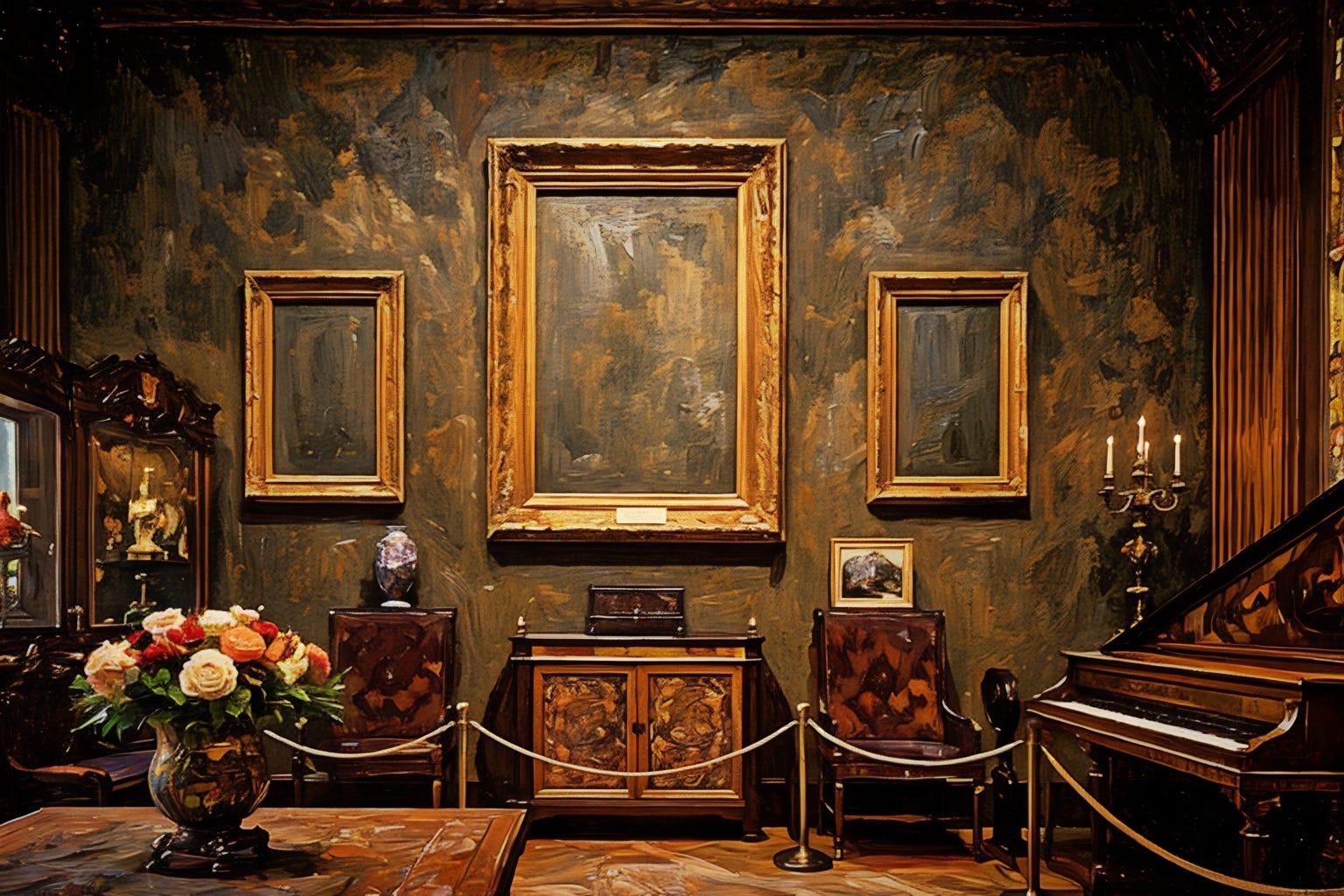
The Isabella Stewart Gardner Museum still displays the empty frames where the works once hung. The museum’s founder required that the galleries remain unchanged, so the empty rectangles remain exactly where the paintings disappeared.
Visitors often treat them as memorials.
They may also be a map.
Investigators still believe the paintings likely survived. They are too useful as leverage to destroy and too famous to sell openly. Somewhere—perhaps in a storage locker, perhaps sealed inside a crate that no one has opened in decades—the works may still exist.
Or they may simply have moved again, passing quietly through the same networks that carried them away in the first place.
If they do still exist, they are unlikely to be hanging in a secret collector’s gallery.
More likely they are stored the way criminal assets are stored—quietly, anonymously, waiting.
Waiting the way a refrigerated truck might sit for a few minutes at a loading dock before dawn, its cargo sealed inside, indistinguishable from everything else moving through the system.
⸻
Bibliography
1. Boston Globe. “Former FBI Agent Reveals New Leads in Gardner Museum Heist.” March 2026. Reporting on retired FBI investigator Geoffrey Kelly and new information from informants connected to the case.
2. Federal Bureau of Investigation. “Isabella Stewart Gardner Museum Theft.” FBI Art Crime Team case file describing the 1990 robbery and ongoing investigation.
3. Isabella Stewart Gardner Museum. “The 1990 Theft.” Museum archival materials describing the stolen artworks and circumstances of the robbery.
4. Ulrich Boser. The Gardner Heist: The True Story of the World’s Largest Unsolved Art Theft. HarperCollins, 2009. Comprehensive history of the robbery and investigative theories involving organized crime.
5. Anthony Amore and Tom Mashberg. Stealing Rembrandts: The Untold Stories of Notorious Art Heists. Palgrave Macmillan, 2011. Analysis of art theft networks and law enforcement investigations.
fascinating
Whadya know... interesting....