What’s in a Name
Follow the trail with us at rottendog.com


The world is not short of stories. It is buried in them.
Some are reported. Some are made. Some arrive carrying the marks of authority: a government seal, a studio desk, a blue check, a solemn voice, or a crowd already shouting what they mean. By the time they reach us, the important part is often gone.
The Rotten Dog exists to go after that part.
Which brings us, inevitably, to the name.
It is not a joke, though it started with dogs. Among people who love Rottweilers, “rotten dog” is a term of affection — a teasing name for a breed that is powerful, stubborn, comic, loyal, and far more thoughtful than its reputation allows.
That does not make the name unserious. Apple was not an apple company. Amazon was not a river. Yahoo was not just Louisiana slang. Twitter was not just bird chirps. None explained the work literally. The work gave the name its meaning.
So will The Rotten Dog.
Twenty years ago, my wife and I produced a cooking show called Something Cooking. It began as a hobby gig and became a production company, Rotten Dog Productions. The name came from the Rottweilers in my life. I have had five of them. They were not props, mascots, or branding exercises. They were great dogs, and each one enlarged my respect for the breed.
A Labrador, it is said, thinks, What can I do for you? A Rottweiler thinks, Let me consider that.
Anyone who has lived with one knows the truth in that line. A good Rottie is not slow, dumb, or casually disobedient. It is weighing the room. It wants to know the job before it gives itself to the job.
One of mine, Laika, taught me that the hard way. She was one of the best dogs I ever had and one of the most difficult to train, in part because I was trying to make her fit the ordinary expectations of obedience. She had other views. Then one exceptional trainer — we called her, with admiration, our canine dominatrix — told me the thing I should have understood sooner: Rottweilers need work. More than praise, more than repetition, more than correction, they need a job.
Try agility, she said. Or scent training.
Laika chose scent.
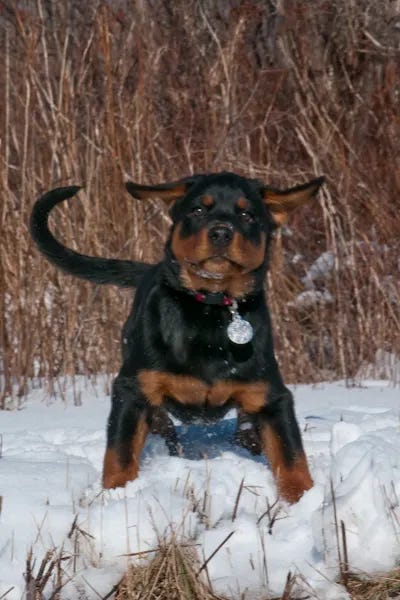
She took to it like a fish to water. Once she understood the game, it was no longer my exercise; it was her domain. She poked me, prodded me, and insisted that I hide things so she could search for them. I thought I was training the dog. The dog had decided I was support staff.
Eventually, we joined NASAR, the National Association for Search and Rescue. We were never called into the field, but the work stayed with me, and so did the lesson. A good search dog does not start with the answer. It starts with the trail. It does not care which version is popular, does not stop because the ground gets difficult, and does not mistake noise for evidence. It keeps its nose down and follows what is actually there.
That is the spirit behind The Rotten Dog.

I’ll still be right here on Substack. But if your inbox is anything like mine, I know I am sometimes just contributing to the clutter. Hundreds of messages fly by. You miss some. You mean to go back to others and never do. And somewhere in that pile may be a story you would have wanted to read.
There is another problem, too. Not every reader comes for the same trail. Some are most interested in climate. Some follow courts, money, media, institutions, local government, or the long drift of political power. If a reader comes for one of those subjects and the next few posts are about something else, the thread can disappear.
rottendog.com is meant to make the work easier to follow. The stories will still appear on Substack, but the site will classify, search, and arrange them as a readable online newspaper. Readers will be able to find the subjects that matter to them, follow related stories, and return to the record without depending on the inbox to preserve the trail.
One more thing — yes, I really do miss Steve Jobs — rottendog.com will also have audio reading on every article, with translations into multiple languages coming soon. That matters to me. A newspaper should be easier to enter, not harder; easier to hear, search, return to, and share across whatever boundary keeps a reader from the story.
I am expanding my daily work on Substack into a non-profit, ad-free online newspaper: no advertisers to satisfy, no sponsor to protect, no party line to repeat, no platform mood to chase.
I intend to keep it free while it grows toward its first 10,000 subscribers. A few recent stories have already reached more than 20,000 readers, enough to show that the audience is there. The next question is whether that attention can become a durable readership.
Independence does not make the work true. It only makes the work possible.
This is not a newspaper of “both sides.” That habit lets one person lie, another person answer, and the story end as if truth were merely a matter of balance. The work begins somewhere else.
A claim is made. I ask who made it, who benefits from it, what institution carried it, what law, money, or institutional pressure helped it move, what evidence supports it, what evidence complicates it, and who was left to live with the result.
Not “trust us.” Not “everything is fake.” Not opinion dressed up as reporting.
Just the record, followed as far as it will go.
The Rotten Dog will publish what was said, what was done, what changed, what does not fit, and what still cannot honestly be known. It will show enough of the trail for readers to make up their own minds.
I started my daily Substack over a year ago out of frustration with the country’s drift toward noise, spectacle, and institutional dishonesty. This project grows out of that work. The Rotten Dog will add journalists who share the same approach: slow down, look closely, and stay with the facts even after the easy version has passed.
The world will keep producing stories.
We’ll be out back, nose down, following the scent. We’ll be at Rottendog.com.
Very interesting post. I look forward to following RottenDog -- as I have your orginal Substack for the last year.